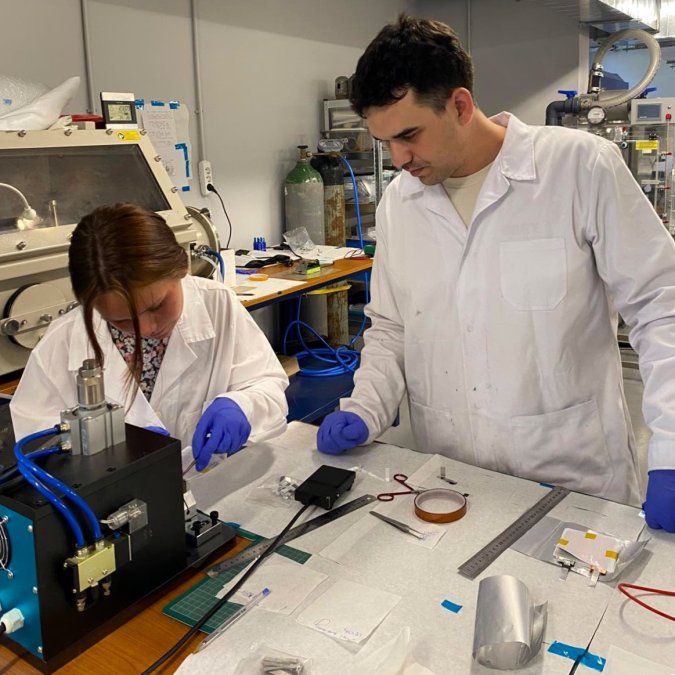
International Research Mobility Advances Lithium-Ion Battery Research: From Laboratory Materials to Larger Battery Cells
Promising battery materials often perform well in the laboratory – but can they maintain that performance under conditions closer to real-world industrial applications? A three-month research stay at the Foundation for Research and Technology – Hellas (FORTH) is helping doctoral researcher Tereza Špitálská address this challenge. At FORTH, she is testing advanced battery separator materials developed at Jan Evangelista Purkyně University (UJEP) and examining how they perform as the research progresses from small laboratory cells to larger, more practical battery formats.
The work brings together complementary expertise from three organisations involved in different stages of battery development. UJEP contributes the design and preparation of advanced separator materials, FORTH provides specialised electrochemical characterisation, and Pleione Energy supports their validation in larger battery cells. By combining these capabilities, the Czech and Greek partners are generating the robust data needed to assess whether promising laboratory materials can move closer to industrial application. The collaboration also strengthens scientific exchange across the INERRANT consortium and contributes to the wider goal of developing safer and more efficient lithium-ion batteries.
A Critical Component in Lithium-Ion Batteries
Špitálská’s research at UJEP focuses on the development of advanced polymeric membranes designed to function as battery separators.
“At my home institution, UJEP, my primary research focus lies in the meticulous formulation and architectural modification of advanced polymeric membranes,” she explains. “These membranes are specifically engineered to function as separators – a paramount component within lithium-ion batteries that prevents internal short-circuits while facilitating optimal ionic transport.”
Although separators do not store energy themselves, they play an essential role in battery safety and performance, keeping the battery’s electrodes physically apart while allowing ions to move between them during charging and discharging. Špitálská’s stay at FORTH connects this materials-development work with advanced electrochemical testing. It enables the researchers to investigate not only the membranes’ fundamental characteristics, but also their stability, durability and suitability for use in larger battery formats.
From Coin Cells to Pouch Cells
The testing follows a two-stage process, beginning with small coin cells before progressing to larger pouch cells. Coin cells are standardised laboratory batteries measuring approximately 15 millimetres in diameter. Their small size and controlled design allow researchers to screen different separator formulations efficiently and establish their fundamental electrochemical properties. The most promising formulations are then taken a significant step closer to practical application. In cooperation with Pleione Energy, the same separator materials are integrated into pouch cells measuring 10 × 10 centimetres.
This transition involves much more than simply increasing the dimensions of the battery. Larger cells require substantially more material and introduce additional challenges related to manufacturing, geometry, heat distribution and cell assembly. A material that performs well in a small laboratory cell may behave differently when used at a larger scale. Testing identical separator formulations in both coin and pouch cells therefore allows the partners to compare their performance under different conditions. The results can reveal discrepancies between small-scale screening and larger-cell operation, helping the researchers identify areas for improvement and further optimise the materials.
Strengthening Skills and Scientific Networks
Alongside the scientific outcomes, the research stay has given Špitálská the opportunity to gain experience with equipment, methods and expertise that complement the resources available at her home institution. Working with specialists in materials science and electrochemical energy storage, she has expanded her practical knowledge of battery testing while building connections within an international research environment.
“I would like to express my profound gratitude to the hosting team at FORTH for welcoming me into their ranks and providing an environment characterized by unparalleled academic rigor and camaraderie,” Špitálská reflects. “This stay has been immensely educational and inspiring. I am deeply honoured to contribute to this prestigious collaboration and look forward to the continued mutual growth of our institutions.”
Her experience illustrates the broader value of international research mobility within EU-funded projects. By giving early-stage researchers access to different facilities, methods and scientific perspectives, research stays can accelerate both individual development and collaborative innovation.
The partnership between UJEP, FORTH and Pleione Energy demonstrates how complementary expertise can support the entire development pathway – from the design of new materials and laboratory-scale evaluation to testing in larger cells that more closely reflect future industrial applications.